UAE Visa on Arrival for Six Additional Nationalities: Eligibility, Fees and Rules for 2026

By
Marcus Richard
| Update on: Jul 29, 2026
The United Arab Emirates has expanded its visa-on-arrival policy to eligible visitors from six additional countries.
Under the decision effective from 25 June 2026 , eligible citizens of Indonesia, Vietnam, Thailand, the Philippines, Kenya and South Africa may obtain a UAE visa on arrival when they meet the applicable passport and residence-permit conditions.
Eligible visitors may receive either a 14-day visa or a 60-day visa on arrival . Accompanying family members may also qualify, provided they meet the applicable conditions.
The policy may make travel to the UAE more convenient for eligible residents living in countries such as the United States, the United Kingdom, Canada, Australia, Japan, Singapore and a European Union Member States.
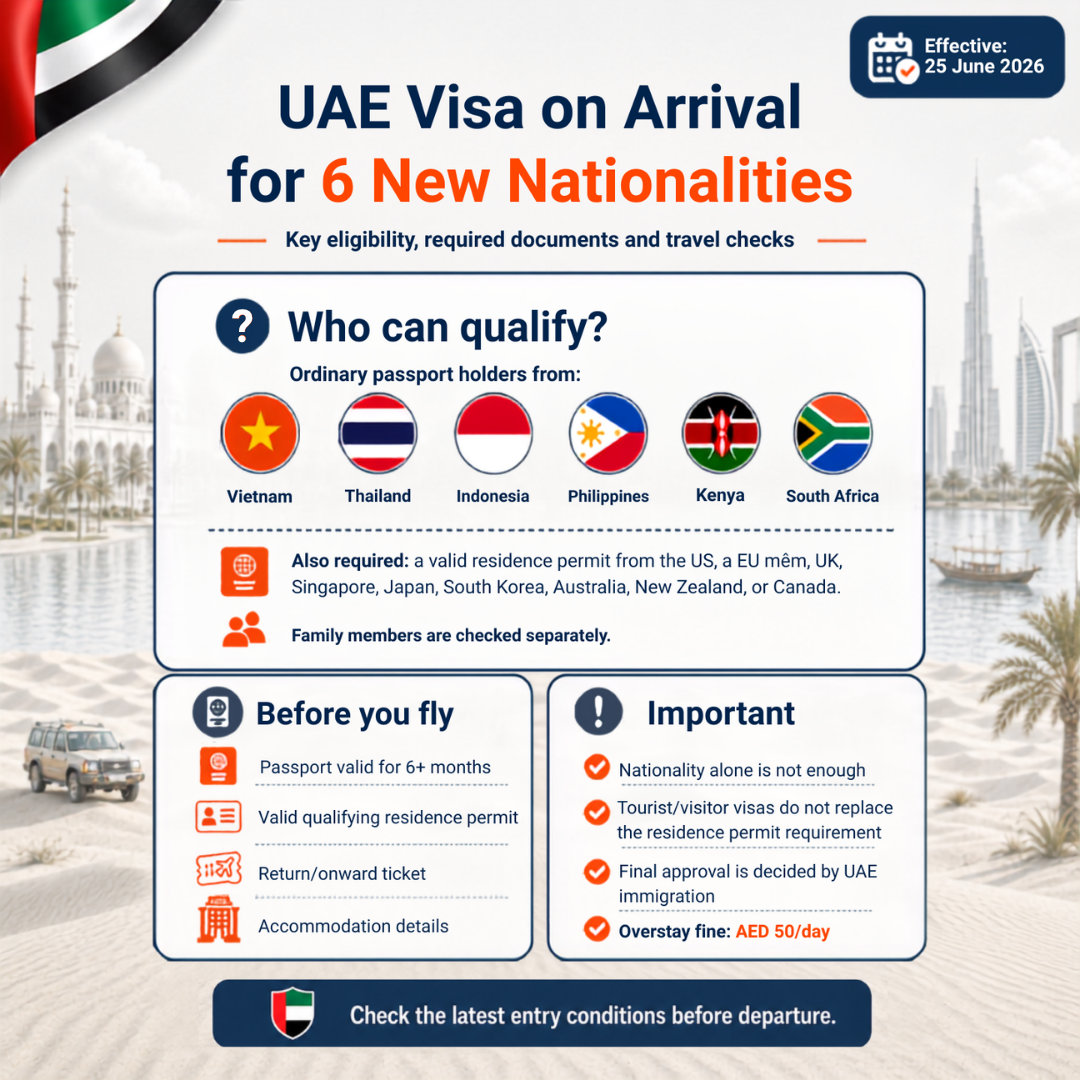
This image was created by AI tool
Who Is Eligible for the UAE Visa on Arrival?
To qualify under the expanded programme, visitors must meet all relevant conditions.
Eligible nationalities
The policy applies to ordinary passport holders from:
- Vietnam
- Thailand
- Indonesia
- The Philippines
- Kenya
- South Africa
Holding a passport from one of these countries does not automatically guarantee eligibility.
Valid residence permit requirement
Visitors must also hold a valid residence permit issued by one of the following jurisdictions:
- United States
- a European Union Member State
- United Kingdom
- Singapore
- Japan
- Republic of Korea
- Australia
- New Zealand
- Canada
The official announcement refers specifically to a residence permit. The published eligibility condition refers to a valid residence permit, rather than a short-term visitor or tourist visa.

Visitors from six nationalities need to meet the accompanying requirements to apply for Visa on Arrival
For example, a Vietnamese traveller holding only a Canadian visitor visa should not assume that the visa satisfies the residence-permit requirement.
Accompanying family members must meet the relevant conditions
Accompanying family members may also benefit from the programme, but eligibility should be checked for each person separately.
Family members should generally:
- Hold an ordinary passport from one of the six eligible countries
- Hold a valid residence permit from an accepted jurisdiction
- Meet the UAE’s passport and entry-document requirements
- Carry proof of family relationship when relevant
Because the announcement refers to “accompanying family members,” travellers may consider carrying documents showing the family relationship, particularly when travelling with children. However, the official announcement does not publish a detailed list of relationship documents required at the border.
Visitors should not assume that one family member’s residence status automatically covers the entire group.
How Long Visitors Can Stay in the UAE?
Eligible visitors may be issued one of two visa types:
14-day visa on arrival
The 14-day visa allows a short stay in the UAE and may be extended once for a further 14 days while the traveller is inside the country.
Any extension should be completed before the original stay expires and remains subject to UAE immigration approval and applicable fees.
60-day visa on arrival
The 60-day visa allows a longer single stay in the UAE.
According to the announcement, this visa is not extendable. Visitors must leave the UAE before the permitted stay expires unless they obtain another appropriate immigration status.
Visitors should carefully check their visa record after arrival to confirm the exact expiry date and permitted length of stay.
What Fees May Apply to the Visa on Arrival?
The issuance fees for a Visa on Arrival will be charged when you arrive in this country.
Visitors should be prepared to use a payment method accepted at the UAE port of entry.
Visa fees and payment procedures may change, so passengers should confirm the latest requirements before departure.
What Documents Should Visitors Prepare?
Although the visa is issued on arrival, visitors should still prepare their documents before flying.
Recommended documents include:
Officially published requirements
- Ordinary passport from an eligible country.
- Passport valid for at least six months.
- Valid qualifying residence permit.
- Recent colour photograph with a white background, where requested during processing.
Additional travel documents to keep available
- Travellers are encouraged to carry a return or onward ticket
- Accommodation details.
- Travel itinerary.
- Evidence relating to accompanying family members.
The original residence card or officially recognised proof of residence should be carried where possible. Visitors relying only on screenshots or informal digital copies may face additional checks.
Passengers should also ensure that names, passport details and residence-permit information are consistent across all documents.
Do Eligible Visitors Need to Apply in Advance?
Visitors who meet all the announced conditions may obtain their visa when they arrive in the UAE and may not need to arrange a standard entry visa before departure.
However, a pre-arranged visa may still be required when:
- The traveller does not hold an eligible passport
- The residence permit was not issued by an accepted jurisdiction
- The residence permit has expired
- The traveller holds only a tourist or visitor's visa
- The passport type is not covered
- The intended activity requires another visa category
Anyone uncertain about their eligibility should confirm the rules before booking non-refundable travel arrangements.
Is a Visa on Arrival Guaranteed?
Eligibility for a visa on arrival does not provide an unconditional guarantee of entry.
Final admission remains subject to checks conducted by UAE immigration authorities. Airlines may also review passenger documents before boarding.
Visitors may be asked to provide evidence of:
- Valid passport and residence status
- Purpose of travel
- Accommodation
- Return or onward travel
- Sufficient financial resources
Immigration officers retain the authority to make the final entry decision.
Can Visitors Work in the UAE With This Visa?
No. A short-term visa on arrival should not be treated as permission to work in the UAE.
Visitors planning to work, study, reside or conduct activities requiring separate authorisation must obtain the appropriate visa or residence status.
The visa-on-arrival programme is intended for temporary visits, such as tourism, family visits or other permitted short-term travel.
What Happens If a Traveller Overstays?
Visitors must leave the UAE before their authorised stay expires or complete an approved extension where permitted.
The announced overstay fine is AED 50 per day .
Overstaying may also lead to additional immigration procedures and could affect future UAE travel. Visitors should therefore confirm their last permitted day of stay immediately after arrival.
What Visitors Should Check Before Flying
Before travelling to the UAE, passengers should:
- Confirm that their nationality is included.
- Check that they hold an ordinary passport.
- Verify that an accepted jurisdiction issued their residence permit.
- Ensure that the residence permit remains valid.
- Check every accompanying family member separately.
- Prepare return tickets, accommodation details and supporting documents.
- Review the latest UAE entry requirements before departure.
Frequently Asked Questions
Can Vietnamese citizens now receive a UAE visa on arrival?
Yes. Eligible Vietnamese citizens holding ordinary passports may obtain a 14-day or 60-day visa on arrival when they hold a valid residence permit issued by one of the recognised jurisdictions
Are all Filipino passport holders eligible?
No. Filipino nationality alone is not sufficient under this programme. The traveller must also meet the valid residence-permit condition and other applicable entry requirements.
Can a South African citizen living in Canada use the programme?
Yes. A South African ordinary-passport holder who holds a valid Canadian residence permit may qualify, subject to all applicable document checks and the final immigration decision.
Does a valid US tourist visa qualify?
Not under this specific residence-permit-based programme. The official announcement requires a valid US residence permit, rather than a US tourist or business visa. Travellers holding only a visitor visa should not assume that they qualify.
Can the 14-day visa be extended?
Yes. The 14-day visa may be extended once for a further 14 days, subject to the applicable immigration procedure and fees.
Can the 60-day visa be extended?
No. The 60-day visa is issued for a single stay and is not extendable.
How much is the overstay fine?
The announced overstay fine is AED 50 per day after the permitted stay expires.
Final Advice
The UAE’s expanded visa-on-arrival programme is a significant development for eligible visitors from Vietnam, Thailand, Indonesia, the Philippines, Kenya and South Africa.
Eligible travellers may be issued either a 14-day or a 60-day visa, subject to the applicable immigration assessment and visa category. However, they must hold both an eligible ordinary passport and a valid residence permit from one of the recognised jurisdictions.
Visitors should verify their documents before flying, prepare supporting travel records and avoid assuming that nationality alone provides visa-on-arrival access.
Official Sources
Related Articles
-
Taxi Fares in Dubai: 2026 Guide to Prices, Routes, Calculations, and Tips
-
Dubai in February: Weather, Things to Do, Day Trips and Travel Tips
-
Dubai in January: Weather, Things to Do, Shopping, Beaches and Day Trips in 2027
-
Etihad Rail 2026 Update: Current Routes, Stations and Passenger Network Timeline
-
Dubai in Winter: Weather, Attractions, Activities and Shopping
-
Tipping in Dubai: The Complete 2026 Guide for Tourists
View more


 United States
 United Kingdom
 Viber
Viber  Telegram


